Republic of Texas Currency and the Redback

For nine years, from 1836 to 1846, Texas was its own country. The Republic of Texas ran an army, staffed a government and tried to build an economy, all without the tax base or credit of an established nation. To pay its bills, the Republic did what cash-poor governments have always done: it printed money. The paper currency that resulted, star money and later the redback note, is some of the most collected and most studied currency in American history, and it still turns up today in Arlington-area estate collections and family papers.
Star Money: The First Republic Notes
The Republic's first major currency issue came in 1837, during the financial panic that swept the United States that year. The Texas Congress authorized interest-bearing promissory notes, paying 10 percent annually and due twelve months from the date printed on the note, to cover government expenses and keep commerce moving. These notes became known as star money for the large five-pointed star printed on the face of each bill. Unlike a modern banknote, a star money note was not payable to the bearer on sight. The payee's name was written in by hand and the note was transferred by endorsement, much like a bank draft passed from person to person.
An early printed series of star money held its value reasonably well, trading at or close to face value in specie. A later engraved series was less fortunate, slipping in value within about a year of issue as the Republic's finances worsened. Star money is scarcer today than the redback notes that followed it, and surviving examples, especially in higher denominations, are prized by collectors of Texas paper currency.
The Redback: Texas's Most Famous Currency
In January 1839, under President Mirabeau B. Lamar, the Republic authorized a much larger issue of notes, printed with red ink on the reverse to help distinguish them from earlier currency and from counterfeits. Texans nicknamed them redbacks, and the name stuck. Over the next year and a half the Texas treasury put well over two million dollars in face value of redbacks into circulation, in denominations that ranged from small change notes up to large bills meant for government and merchant transactions.
Republic of Texas Redback
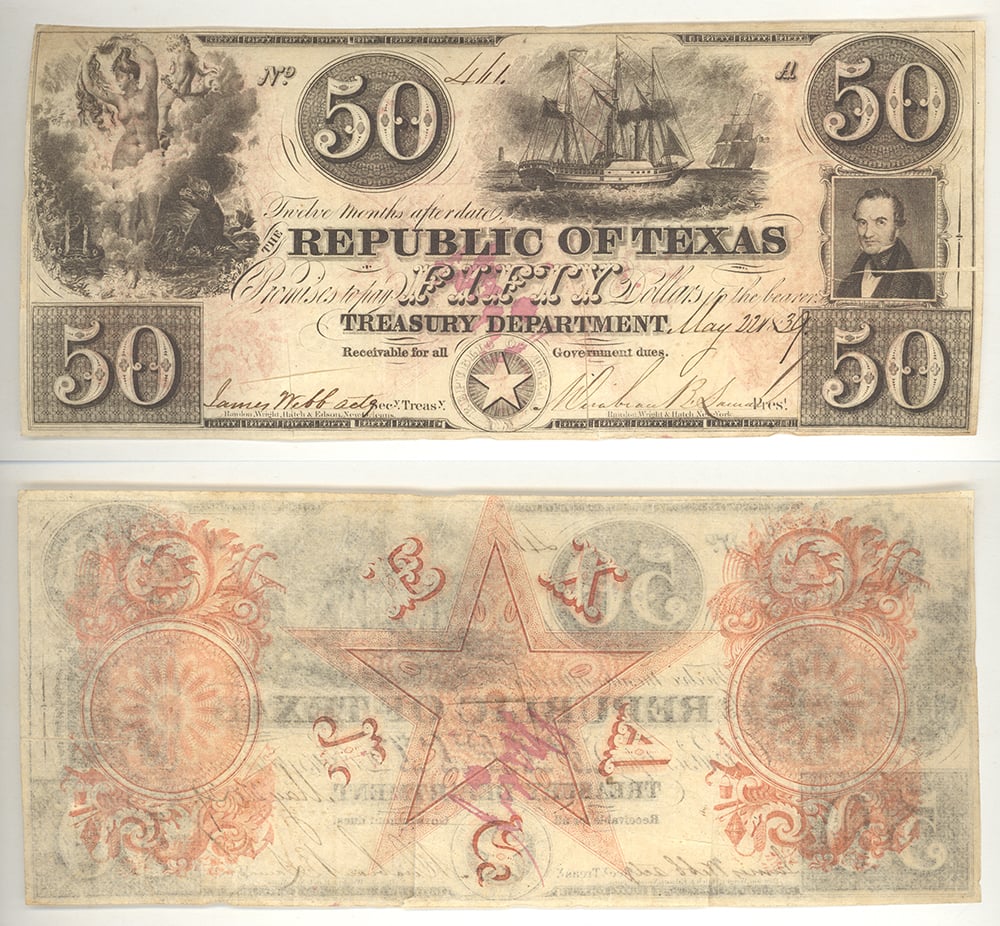
- Issuer
- Republic of Texas
- Type
- Redback note
- Circulated
- 1839 to 1842
- Named for
- Red ink on reverse
The redback's story is really a story of depreciation. The notes launched at a fraction of their face value in hard currency, and as the Republic's treasury kept issuing more paper to cover its debts, that value kept falling. By the winter of 1841 to 1842, redbacks were changing hands in some parts of Texas for only a few cents on the dollar, and in February 1842 the government stripped them of their legal tender status for paying taxes. Texas eventually worked to redeem outstanding redbacks at something closer to their real market value rather than their printed face amount, a practical if painful acknowledgment of how far the currency had fallen.
Why Republic-Era Notes Are Collectible Today
Star money and redback notes survive today because Texans of the era saved them, first as legal documents and later as souvenirs of a currency that never quite worked. Condition varies enormously, from notes that are heavily worn and repaired to a smaller number that survive crisp and well preserved, and grade has a large effect on desirability. Rarer denominations and less common signature combinations tend to draw the strongest interest from collectors, while common redback denominations in worn condition are more affordable entry points into the field.
We do not publish exact catalog prices here, since values shift with the market and depend heavily on a note's condition, denomination and paper quality. For a sense of current ranges, established currency and coin price guides such as the PCGS Price Guide are a reasonable starting point, alongside recent results at reputable currency auctions. If you have inherited or found Republic-era notes, our coin values guide covers the basics of how condition and rarity drive price, and our selling guide walks through what to expect when you take a collection to a local buyer.
For a deeper dive into the Republic's finances and currency issues, the Texas State Historical Association's Handbook of Texas maintains a detailed entry on Republic-era money, and the Smithsonian National Numismatic Collection holds examples of both star money and redback notes in its collection.