Gold and Silver on the Texas Frontier

While the Republic of Texas experimented with paper money that never quite held its value, most everyday trade on the Texas frontier ran on something older and more trusted: hard coin. Long before the United States Mint had much presence in Texas, Spanish and Mexican silver, along with a scattering of gold, did the real work of buying and selling goods across the frontier.
The Spanish Silver Dollar and "Two Bits"
The workhorse coin of early Texas commerce was the Spanish colonial, and later Mexican, silver eight-reales piece, widely known in English as the Spanish dollar or piece of eight. First minted in the Spanish colonies and struck for centuries afterward, the eight-reales coin became something close to an international currency, circulating throughout the Americas and, well into the 1800s, throughout the United States, where it remained legal tender until 1857.
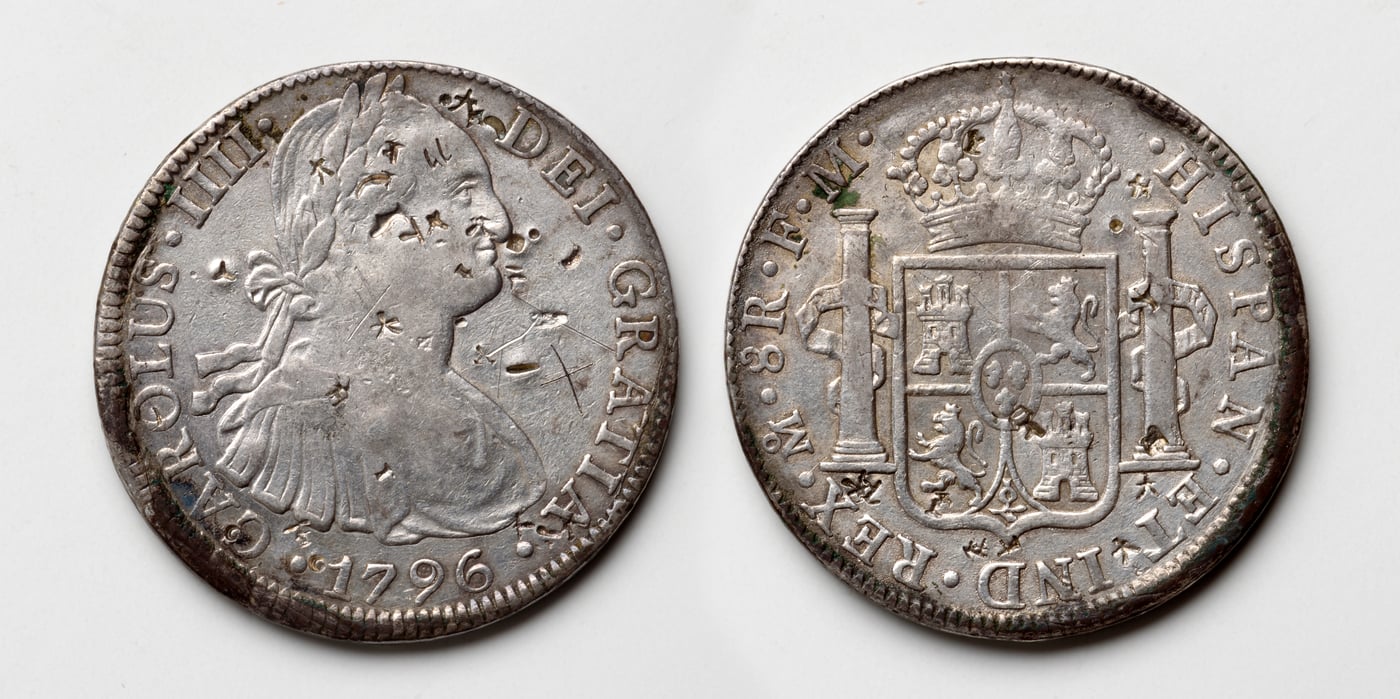
Because small-denomination coins were scarce, an eight-reales piece was sometimes literally cut into wedge-shaped pieces, each equal to one real, to make change for smaller purchases. Two of these "bits" made up a quarter of the coin's value, which is the origin of the American slang "two bits" for a quarter dollar, a phrase that outlived the coin itself by more than a century. Given Texas's proximity to Mexico, Mexican silver coinage in particular remained common in Texas commerce well after the Republic era, circulating alongside, and often more reliably than, Republic paper currency.
Legal Money by Federal Law, Not Just Habit
Foreign silver was not merely tolerated in early Texas commerce, it was legal tender under United States federal law for decades. Spanish and later Mexican silver coins remained officially recognized as legal currency in the United States until 1857, when Congress finally ended their legal tender status and pushed the country toward relying exclusively on domestic coinage. For a frontier region like Texas, where federal coin was often slow to arrive in useful quantities, that long legal tolerance for foreign silver was not a technicality. It was one of the main reasons Spanish and Mexican coin remained practical, everyday money well after Texas joined the Union.
United States Coinage Arrives
Texas joined the United States in 1845, and with statehood came a gradual shift toward United States gold and silver coinage. That shift was neither instant nor complete. Federal coin took time to reach a sprawling, sparsely populated state, and foreign silver remained part of everyday Texas trade for years afterward. Over time, though, United States half dollars, dollars, and gold coins became the dominant hard currency in Texas, supplementing and eventually displacing the Spanish and Mexican silver that frontier Texans had relied on for a generation.
Gold played a smaller but real role on the Texas frontier as well, largely in the form of coin rather than raw metal, since Texas itself had no significant gold rush of its own to compare with California's. United States gold coinage, along with occasional private and territorial issues that made their way into Texas through trade, supplemented silver as a store of value for those who had it.
Bullion Value Versus Numismatic Value
Anyone examining old Spanish, Mexican, or early United States coinage today should understand the difference between two kinds of value. Bullion value is simply what the gold or silver in a coin is worth as raw metal, based on its weight and purity and the current metals market. Numismatic value is different: it reflects what collectors will pay for a coin because of its date, mintmark, condition, rarity, or historical significance, and it can run far above, or occasionally below, a coin's simple metal content.
A worn, common-date Spanish eight-reales piece may be worth close to its silver content, while a well-preserved example with a clear mint and date, or an unusual variety, can carry a substantial premium over bullion value. The same principle applies to United States frontier-era gold and silver. Because these distinctions matter so much to what a coin is actually worth, we avoid publishing fixed prices for older foreign or frontier coinage. Owners who want a sense of current ranges can consult a recognized price guide such as the NGC Coin Price Guide, and our selling gold guide and selling silver guide both cover how bullion and numismatic value are weighed together when a local buyer prices a coin.
For background on how Spanish and Mexican coinage functioned as money across the Americas, and on the early history of United States coinage, the Smithsonian National Numismatic Collection and the United States Mint are both useful references.