Texas Commemorative Coins and the 1934 Centennial Half Dollar

A century after the Republic of Texas won its independence, the United States Mint struck a coin to mark the occasion. The Texas Centennial half dollar is the best known Texas-themed coin ever issued by the federal government, and it remains one of the more approachable commemorative coins for a Texas collector to pursue, with a design packed full of state history in a single silver fifty-cent piece.
A Coin Made for a Centennial
Texas won its independence from Mexico in 1836, and as the state's centennial approached in the mid-1930s, a Texas Centennial Committee pushed Congress to authorize a commemorative half dollar to help fund centennial celebrations and monuments. Congress approved the issue in 1933, and the United States Mint struck the coin at three facilities, Philadelphia, Denver, and San Francisco, across five years, from 1934 through 1938, rather than in a single run. Coins carrying different years and mintmarks from this span form the full Texas Centennial series that collectors assemble today.
Texas Centennial Half Dollar
- Denomination
- Silver half dollar
- Struck
- 1934 to 1938
- Mints
- Philadelphia, Denver, San Francisco
- Designer
- Pompeo Coppini
The Design: Coppini's Tour de Force
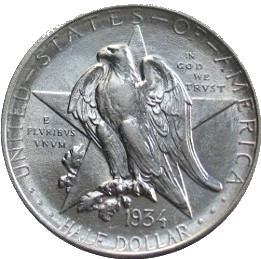
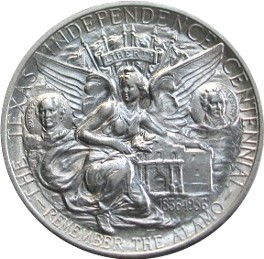
The coin was designed by Pompeo Coppini, an Italian-born sculptor who had already made his name creating public monuments across Texas by the time he took on the commission. The obverse breaks from the usual American coin convention of placing an eagle on the reverse, instead showing a bald eagle perched in front of the Lone Star of Texas. The reverse is the more elaborate side, packing in the winged figure of Victory, a representation of the Alamo, portraits of Sam Houston and Stephen F. Austin, and the six flags that have flown over Texas, all arranged around the coin's central star. Numismatic writers have long called the reverse one of the most crowded and ambitious designs ever put on a United States coin, and it remains a favorite among collectors specifically for that density of Texas history in a small space.
Mintage and Why Certain Dates Are More Sought After
Total production across all five years and three mints came to roughly three hundred thousand coins, a modest figure for a United States commemorative of the era. Sales were strongest in the first year, 1934, when the coin was new and being actively promoted, and fell off considerably in the years that followed as collector interest in the broader wave of 1930s commemorative coins cooled. Because of weak demand, the Treasury ended up melting down a substantial share of the coins that had been struck but never sold, meaning more coins were minted than actually survive for collectors today.
That production pattern is why not all Texas Centennial half dollars are equally available. The 1934 Philadelphia issue, the first and largest run, is the most commonly found today, though many surviving examples show wear from having been kept as pocket souvenirs rather than carefully stored. The later years, 1935 through 1938, were struck in much smaller quantities across all three mints, and combinations from those years are correspondingly harder to find, particularly in higher uncirculated grades. As with any commemorative series, condition matters enormously: a well-preserved, high-grade example of even a common date can be worth many times a worn, heavily circulated one.
What a Texas Centennial Half Dollar Is Worth
We do not publish fixed prices for the Texas Centennial series here, because value depends heavily on the specific year, mint, and grade of an individual coin, and because prices shift with the broader collector market. For current, condition-specific price ranges, the PCGS Price Guide and the NGC Coin Price Guide are both well-regarded starting points, and either service can also formally grade a coin if you want a certified opinion before selling or insuring it. If you are trying to work out what a Texas Centennial half, or any other older coin, might be worth in general terms, our coin values guide explains the basics, and our key date coins guide covers how scarcer dates and mints earn a premium over common issues.
For the coin's official history, the United States Mint documents its commemorative coin programs, and the Smithsonian National Numismatic Collection holds examples of the series alongside other American commemorative issues.